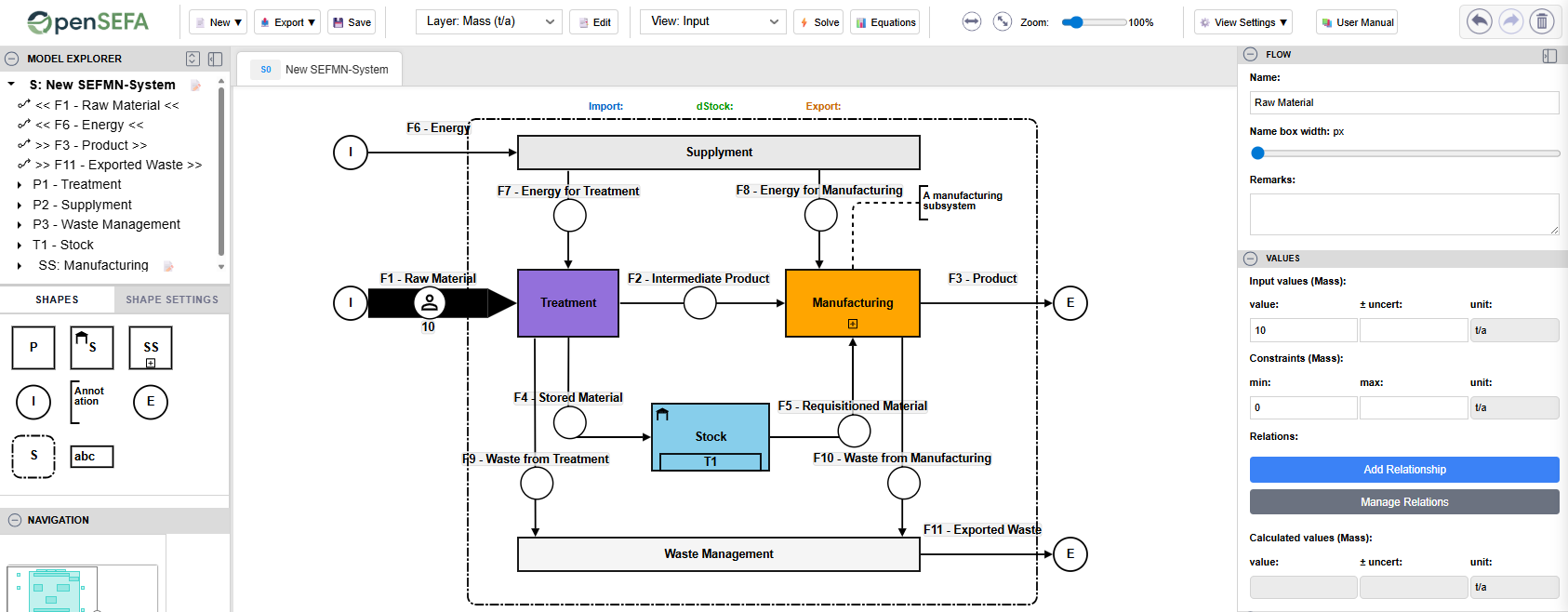
OpenSEFA models material, substance and energy flows along industrial process chains. Processes, stocks, flows and system boundaries are drawn in a Sankey-style diagram and solved as one physically constrained system. The method continues the substance-flow approach known from STAN: visual models, layered goods, substances and energy, and data reconciliation.
Material and energy flow analysis maps the flows and stocks of a defined system, for example a production plant, a municipality or a national economy. It supports process analysis and optimization, helps identify resource-saving and efficiency potentials and provides a basis for further calculations such as CO₂ accounting. In practice, field and inventory data are often sparse, uncertain and mutually inconsistent: combined, they violate conservation of mass and energy. OpenSEFA adjusts measured values by nonlinear data reconciliation and calculates the uncertainties of unknown quantities by uncertainty propagation, subject to balance constraints generated automatically from the diagram.
Features
What OpenSEFA covers
The workflow from model building to export runs in one browser application.
Visual modeling
Place processes, stocks and subsystems on the canvas and connect them with flows, in the Substance & Energy Flow Modeling Notation (SEFMN).
Mass, energy and substance layers
One model holds mass, energy and substance layers, so they can be tracked separately through the system and solved together.
Data input
Enter measured values with uncertainties, fixed values and bounds, transfer coefficients for processes and optional linear relationships between flows.
Data reconciliation
The solver estimates the most probable values from measurements, uncertainties and balance constraints and computes unmeasured flows where possible.
Uncertainty propagation
After reconciliation, uncertainties are propagated through the model structure, so the uncertainty of calculated quantities stays visible.
Aggregation layers
Optional aggregation layers support follow-on accounting such as CO₂ emissions, costs and other derived quantities. CO₂ accounting is already implemented.
Transparent solving
Inspect the generated equations and the solve results. Infeasibility diagnostics point to models that cannot be solved.
Export and user manual
Export models as JSON and diagrams as images for documentation and reporting. An integrated user manual explains MFA/SEFA concepts, the workspace and layer configuration.
How it works
From diagram to reconciled model
1
Build the model
Draw processes, stocks and subsystems and connect them with flows.
2
Enter data
Add measured values with uncertainties and bounds, transfer coefficients and optional linear flow relationships.
3
Solve and analyze
The balance equations from the diagram are sent to the solver automatically. Reconciled results return to the interface for analysis and export.
Availability
Open components of OpenSEFA
Commercial deployment or integration may require separate arrangements with Matplus, as the component licenses differ.
Web application
Free browser application at opensefa.matplus.eu, including the user manual. Email registration is required.
Solver OpenSEFA.jl
Source and documentation on GitHub, under the PolyForm Noncommercial License 1.0.0.
Editor source
Available from Matplus on request. A valid JointJS+ license is required.
Feedback
OpenSEFA is an active research prototype. Matplus welcomes feedback, ideas and suggestions from users to guide further development.
Frequently asked questions
What is the difference between MFA and SEFA?
Material Flow Analysis (MFA) quantifies the material flows and stocks of a system. Substance and Energy Flow Analysis (SEFA) extends MFA to coordinated mass, energy and substance layers, which are tracked separately through the system.
What does OpenSEFA cost?
The web application at opensefa.matplus.eu is free of charge. Email registration is required.
How does OpenSEFA relate to STAN?
OpenSEFA provides similar functionality to STAN, where graphical MFA modeling, nonlinear data reconciliation and uncertainty propagation were established (Cencic, 2016). In addition, OpenSEFA combines reconciliation with aggregation layers for follow-on accounting, uses a solver designed for large systems that respects variable bounds, and runs in the browser with an openly available solver and JSON model exchange. The OpenSEFA.jl solver can also import and solve models from STAN.
Which solver does OpenSEFA use?
OpenSEFA.jl, a Julia package. The optimization problem is formulated once in JuMP, so different numerical solvers can be used without rewriting the model. A presolve stage simplifies the system before the numerical optimization. The package also offers an HTTP API for integration with external tools.
Is the reconciled solution guaranteed to be globally optimal?
No. Reconciliation uses a local nonlinear optimizer. For nonconvex problems with bilinear constraints, convergence can depend on the initial values, so global optimality is not guaranteed.
Can I use OpenSEFA commercially?
The solver is licensed under the PolyForm Noncommercial License 1.0.0. Commercial deployment or integration may require separate arrangements with Matplus. Please contact us.
Where can I read more about the method?
In the OpenSEFA whitepaper (PDF), in Cencic, O. (2016): Nonlinear data reconciliation in material flow analysis with software STAN, Sustainable Environment Research 26(6), 291–298 (doi:10.1016/j.serj.2016.06.002), and in Brunner, P. H. & Rechberger, H. (2016): Handbook of Material Flow Analysis, CRC Press.
Model your own process chain
Try OpenSEFA free of charge in the browser, or contact us about commercial use, integration or feedback.
We only store in your browser what the website needs, such as your choice in this banner. With your consent, we also use Plausible Analytics, Cloudflare Web Analytics and Google Analytics to understand how our website is used. Your choice is valid for 12 months. You can change or withdraw it at any time via “Cookie settings” in the footer. More in our Privacy Policy.